
January 23, 2019
Text is something we come across every day. But something we don’t always think about is the writer behind that text. We are all capable of becoming authors and writers of all sorts of ideas, stories, poems, etc.
I was working in a 5th grade classroom yesterday, and in the reading section of the day, the students were asked to complete writer’s responses to the classroom novel, and once the assignment was completed they could read, free write, or catch up on other assignments. One child decided to write a story. She had asked if I would read it, but we were changing subjects and there wasn’t enough time. I told her I would read it at the end of the day. Honestly, I felt a sour taste in my mouth after I told her there wasn’t time to read it right now. She was so excited about her writing and I felt like the adult who didn’t have time for a child’s enthusiasm and excitement. Of course when the end of the day rolled around, she ran up to me with her story and asked if I could read it. I was thrilled to read her story! When I picked up her writer’s notebook, she asked if I knew what the dark hour was. I told her no (I’m really not one for anything scary or creepy). So she told me it was 3am and it is the time when bad things happen. Internally I became a little worried, I reallyyy don’t like scary stories. But of course I read her story anyways. She had written three chapters already!! The beginning of her story was engaging, and it had a real hook to it. Truthfully, I wanted her to write more so I could read more! I handed her story back and told her it was incredible because it was truly well written and a well thought-out story! As she took her notebook back, she said, “I have always wanted to write a scary story, and I thought today would be a good day to do it.”
This child has some wisdom to her in her early years. “I always wanted to… and I thought today would be a good day to do it.” We all have aspirations, things we want to try, things we want to experience. No days are ever guaranteed in this life, and we should all use this mantra to live out the fullest life we possibly can while we’re here on this earth.

Text can inspire us, images can inspire us, movies, songs, anything you can think of. But people can inspire us too, writers of all ages, writers of all kinds. If we take the time to listen, we can learn a lot from the world and the people around us. I was reminded that taking even a few short minutes to pay attention to an eager child can make all the difference in the world for them and for you.
Another person that has inspired me through their writing is Amy Krouse. Her book titled Textbook Amy Krouse was thought-provoking, hilarious, and like nothing I’ve ever seen before. Her first few sections reminded me of many stories and people in my life that I had since forgotten. Everything in her textbook seemed so random. Sarcastically written, yet true, honest stories about her life and people she had encountered that left an impression at one time or another. Serendipitous moments seem to occur quite frequently in Amy Krouse’s life. Serendipity usually wiggled into my life when meeting new people. I was working at a gym on campus during undergrad, and I ended up working with three people who grew up within a mile of my childhood home, yet we didn’t meet until I was in my early 20s over 100 miles away from where our parents live. Part of me wonders if we ever met at the neighborhood playground when we were little or if we ever went sledding down the big hill at the same time, but the other part of me believes in the magic of human connection and I’m positive we had all crossed path at one point in time before officially meeting each other in college. Moments like these are ones that stick out because they remind us how small and connected our world really is. I also find these serendipitous moments while reading. One of Amy’s pages talked about an experience she had on Lake Shore Drive. Without her naming the city or state, I knew exactly where she was. Driving along Lake Michigan in Chicago. My parents were born and raised in Chicago where they had me and three of my siblings. My dad’s parents lived only a couple miles away from Lake Michigan, and all of the happy childhood memories came flooding back and I actually shed some tears over it. Chicago was a happy place for me where I was able to see my family and eat the best pizza and play in the “ocean” (when I was little I didn’t understand that Lake Michigan meant it was actuallyyy a lake). It was a happy coincidence that one of Amy’s seemingly random stories brought back so many wonderful memories.
As teachers, we never know what thoughts or memories texts or ideas will bring to our students’ minds. Sometimes they will be happy, sometimes they could be very painful, or somewhere in between. It is our job as the adult in the room to provide our students with care, support, and strategies to help process through emotions. Writing is one strategy we can give to our students when they are having an overwhelming amount of emotions, so they may capture and process through them.
January 30, 2019
This past week consisted of a good balance of reading and writing. I began in my writer’s notebook with an ephemera entry. (Ephemera- saving something that servers as a fodder for writing) I saved a grocery store receipt from Sunday morning and wrote about the enjoyment and excitement of that day. I then created a heart map. This is a creative writing technique that is great for anyone. I drew a heart in my notebook and began writing along the edges things that I love and things that bring me joy. Over time I plan to add to my heart map, maybe even make a new one each year to see how my love has changed.
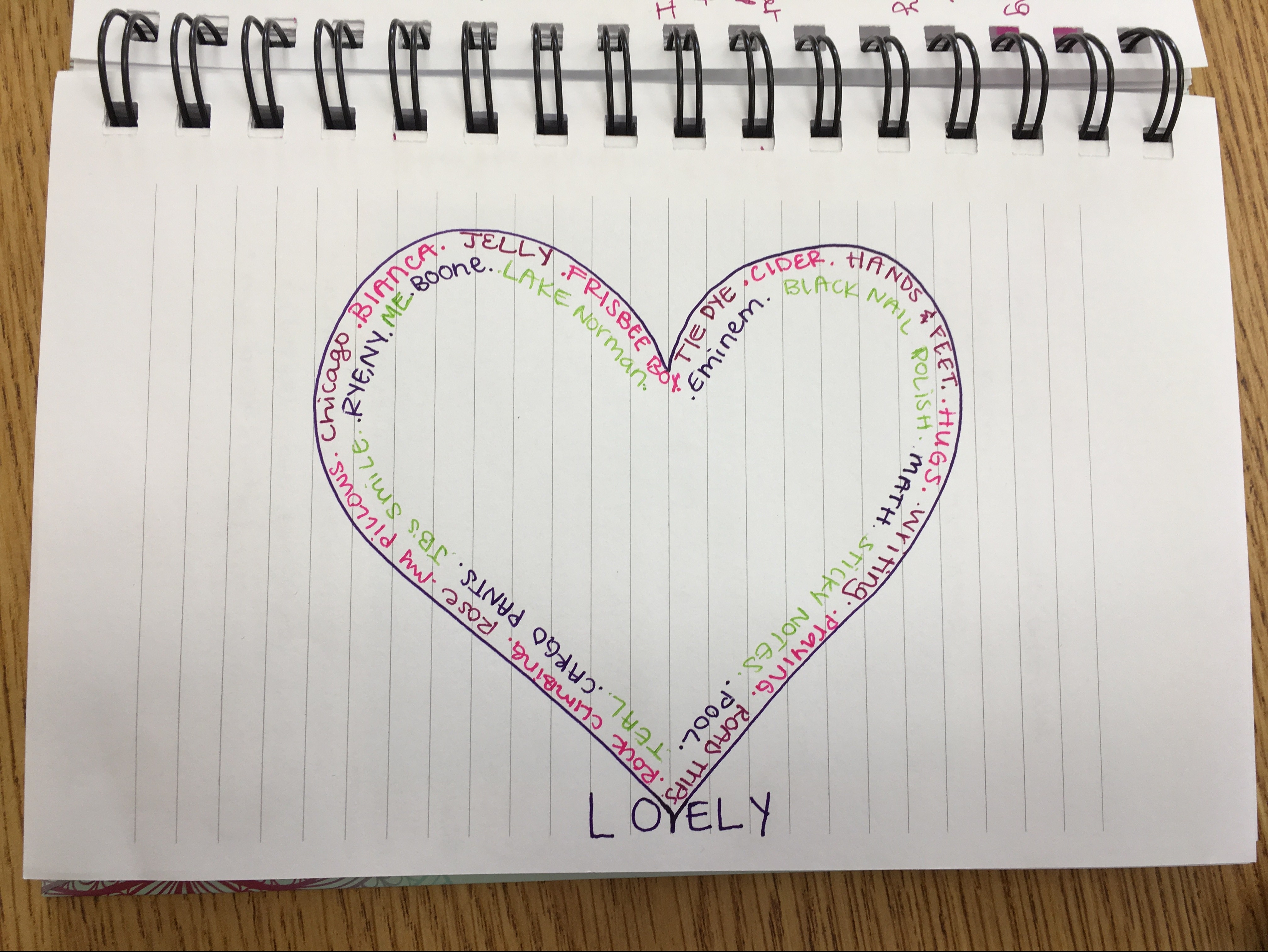
I also decided I would create a section on my notebook to capture funny/entertaining/weird things my students say to me. The first one was a conversation I had with a 5th grader. She walked up to me and said “Why do your socks have ruffles?” To which I answered, “I’m not sure, that’s just the way they came.” She looked back at my socks and concluded, “You look like you’re from the colonial times.” Of course I laughed to myself because the clothes I was wearing did not in fact reflect the colonial times, except for the tiny ruffles on the top edge of my socks. So I smiled and said “They do look like the colonial times.” As teachers, we are told to help our students learn. We are present them with information and guide them in ways to learn how to think critically so they can be independent thinkers. However, our students can teach us SO MUCH in the process.
Everything around us makes us think, we are constantly learning and coming across new and old ideas that challenge us, remind us of things, and make us wonder. Good mentor texts can do the same. These can be books, poems, images, quotes, videos, movies, you name it. I was at a brewery over the weekend and one of the paintings on the wall was the silhouette of an eagle that said “This sky. This sky where we live is no place to lose your wings so love, love, love.” Our wings help us reach out to those around us, they are our talents and our abilities that we use to make a difference, to make connections with the world around us. I didn’t go looking for a quote about life, but it found me in that moment. If we keep our eyes, hearts, and minds open, we can grow as human beings together in this world.
Another mentor text I have been reading is Textbook Amy Krouse Rosenthal. Her writing is inspiring because it is random. Spontaneous. You never quite know what you are going to find when you turn the page. There are drawings, pictures of letters, short two sentence stories. Stories that take up two pages. Poems. Definitions. If you think about it, all of our lives are beautifully random. Everyone has different experiences, yet sometimes we get to share them with others. Writing is a way to capture these moments, these experiences, the highs and the lows that are all part of life. Reading about someone else’s life, whether it is non-fiction or made up, can spark up emotions and memories and teach us new things.
Brown Girl Dreaming is memoir of Jaqueline Woodson’s life. She was an African American who was born in the United States in the early 1960s. She talks about her family and the history behind her blood. This text is written in verse, which allows her to capture small and large moments with few, yet powerful words. One of the stories the narrator tells is the origin of her name. She tells of the reasoning behind her name, the arguments her parents had over it, and how they finally came to the decision of Jaqueline. This piece from her story made me laugh. When I was a child, my siblings and I would always ask our parents why they named us, what other names they had come up with, and what names they really didn’t like. This was intriguing to us because three out of the four of us had family names for our first name. It seemed like a pattern since the oldest three were the ones with the repeated names, but the youngest one had an entirely random name. I decided to write out an entry about the heritage of my name. I began by putting a sticky note down for each name that I have. I wrote one name per sticky note. Then I decided to write little blurbs about where the name came from, any nicknames, who picked out the names, and then I began to remember quirky little memories or revelations about my names..so I added those too.
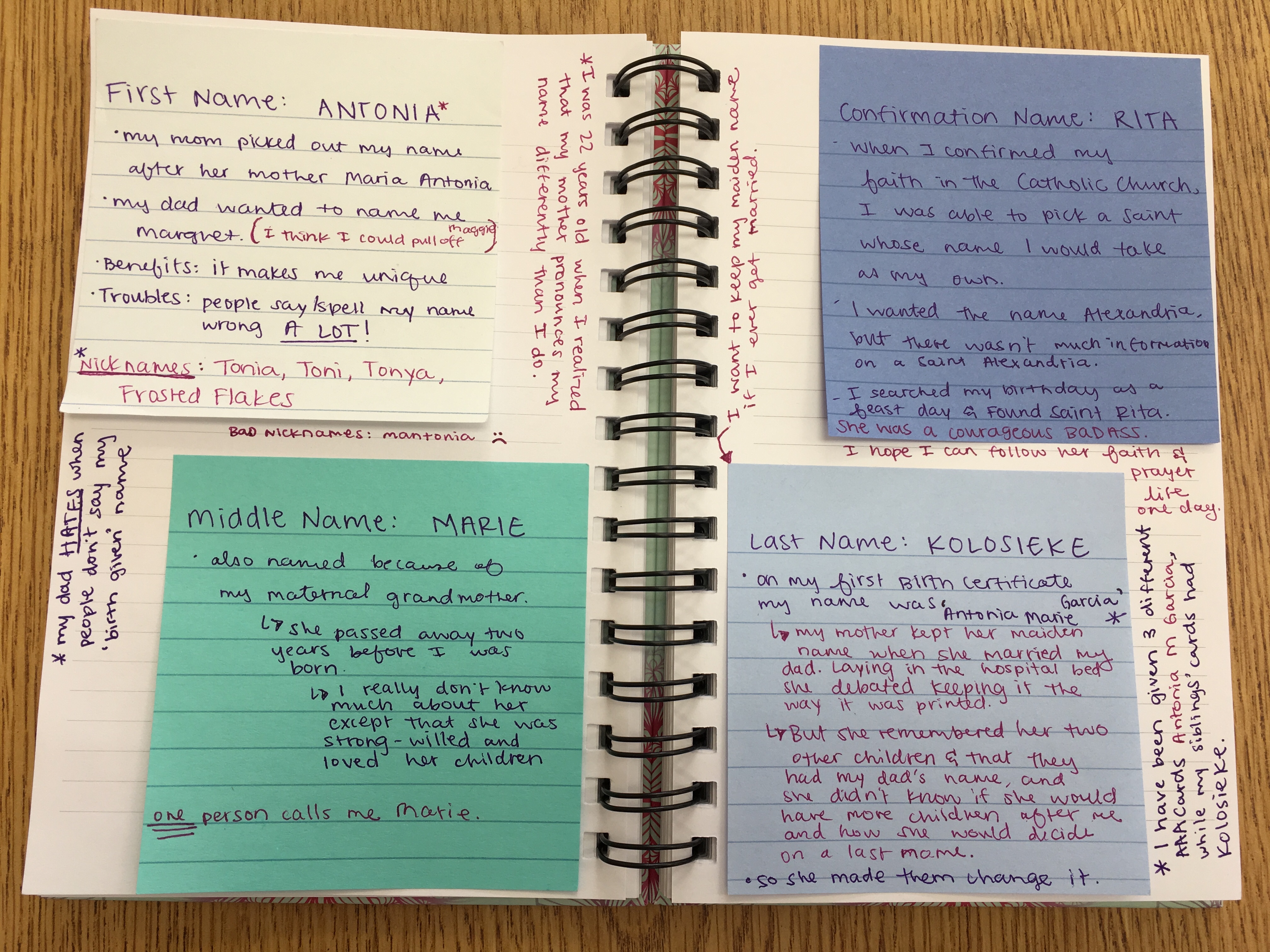
Being a teacher and a writer for even this short time has made an impact on how I view writing in the classroom and in my personal life. I find myself doing things or hearing things that I WANT to write down. Things I don’t want to forget, things I can look back on one day, things that caught my attention or my emotions. In order to be a good model for my students in terms of writing and reading, I need to continue to find mentor texts and allow my hands and brain to work together to capture my thoughts on paper. Or on a computer screen, which ever medium seems more fitting that day.
I encourage you to write, to keep writing, and to one day be brave enough to share your writing.
February 6, 2019
The storyteller is deep inside every one of us. The story-maker is always with us. Let us suppose our world is attacked by war, by the horrors that we all of us easily imagine. Let us suppose floods wash through our cities, the seas rise… but the storyteller will be there, for it is our imaginations which shape us, keep us, create us– for good and for ill. It is our stories, the storyteller, that will create us, when we are torn, hurt, even destroyed. It is the storyteller, the dream-maker, the myth-maker, that is our phoenix, what we are at our best, when we are our most creative.
-Doris Lessing
Creative is inside all of us. We are creative in our own unique ways. Sometimes, tapping into that creativity can be a challenge though. We block our minds off, we numb away our racing thoughts, we tell ourselves ‘I can’t do this’ or ‘I don’t want to do this’, and that’s where we get stuck. However, as a teacher it’s my job and passion to help my students fight that writer’s block, fight the desire to stare at a blank page. Prompts, quotes, questions, passages, novels, are just a few things that can help inspire our writers. Poems, songs, every day interactions can spark up that fire as well. For some people, boxes and rules for writing can be a huge turnoff. Finding a balance for prompting versus a single laid out topic is important when teaching writing.
This week, one of the prompts I was given was to use the Mentor Poem “Where I’m From” by George Ella Lyon. My professor provided us with a worksheet that contained the format of the poem and blanks for us to fill in. I only managed to draft out the first stanza today– I found myself caught in a writer’s block. I liked that the worksheet contained guidelines, so I wasn’t just writing blindly. Yet, I found myself struggling to get started with the first two lines because I had so many options to choose for my first ‘specific ordinary item’. Even though it took some extra effort to create this first draft, I want to share it on my blog so I can have a running set of each draft I write until I am ready to publish the finished poem. I have also included the format worksheet I’ve been following.


Next week am hoping to have drafted the second and/or third stanza of the poem so I can share it here.
While reading through one of my mentor texts, Brown Girl Dreaming, I found myself writing several quotes from Jacqueline Woodson’s poems. One of my favorite uplifting quotes is: ‘What is bad won’t be bad forever, and what is good can sometimes last a long, long time’ (p. 130). A quote that resonated with me is: ‘Hold still now… but the rest of me is already leaving, the rest of me is already gone’ (p. 85).
Different sentences, different words, different emotions behind a text spark many ideas for my writer’s notebook.
February 13, 2019
Kids pick up on everything. They are observant. They notice what people do around them, especially the adults in their life. Their observations allow them to see positive and negative things. My hope is that my students can pick up on the positive things I do, whether I am at the front of the room teaching or sitting at the back of the room while they are completing a task. My goal as a teacher is to model for my students. Model academics, model thinking, model positive interactions, model my humanity. Today was a day that I inadvertently modeled writing.
I am currently working as an Assistant Teacher. Right now, I am in a fifth grade classroom. While the class was watching science videos, I was working in my writer’s notebook. One of the students was sitting next to me, and asked what I was writing. I explained that this is my Writer’s Notebook, it holds my ideas, little stories or memories, and other things that I could later write a whole piece on. I was working on a piece titled ‘Family Genetics’ (which was inspired by Jacqueline Woodson’s poem ‘Genetics’ from Brown Girl Dreaming). I had Brown Girl Dreaming in my lap, and she then asked me if it was a book of poetry. I told her it was a memoir written in short poems, and the student was amazed. I told her that it was a mentor text, something that I can read to gain ideas from; something that helps spark my own writing. I then went back to my entry and kept working while the video was playing. Finally she turned to me and said, “I really want to make my own notebook, but I don’t want you to think I’m copying you!” I smiled and laughed, and clued her in on the secret. I explained that I am doing this for a college class, in order to create my own writer’s notebook so that when I have my own classroom, I can introduce my students to a writer’s notebook and help them create their own. Her face lit up and she said “Oh I am definitely making one then!!” She shifted her focus back to the video, but after a couple minutes she pointed at my sticky note and said she liked how I organized my notebook. She asked if she could look through it, so I told her I would show it to her at the end of the day. (Franticly, my brain tried to think back to my entries to remember if there was anything inappropriate for a child. I couldn’t remember anything bad, but sometimes my memory fails me so I will definitely need to talk her through the notebook in order to skim over what I’ve written.)
*I’m currently working on this blog post during specials, so I’ll fill you in on how the sharing of my writer’s notebook goes later this afternoon*
I stepped out to use the restroom. When I walked into the room, the student was sitting in the chair next to mine and had Ia book open in her hands. Naturally, panic set in as I walked across the room because One: I didn’t know what page she was on. Two: After I write things down, I tend to leave them on the page which means I don’t remember what I wrote UNLESS I open up the page and read the words in front of me. Three: What if I wrote something embarrassing or not appropriate for a 5th grader’s eyes?? As I finally approached my chair, she looked up at me and said, “I started looking at it, I hope that’s okay!” I forced a smile and said, “Yes, of course that’s okay.” I sat next to her, and realized she had opened the notebook and started from the beginning as if my notebook was a storybook or novel between her fingers. It was a bit of a strange feeling watching her read my thoughts. I explained where some of the inspirations came from, I explained what ‘ephemera’ was because she asked why I had a receipt taped to a page. I told her about the poems I had taped to the pages and that I had written little responses after reading the poems. She read the title of the poem “Bathroom,” laughed, and asked me if she could read it. She was laughing halfway through the poem and I told her that the poem was very familiar to my life because my family, too, had a specific window that we would crawl through in order to unlock the door of the house. The student came across a list a written titled: ‘Lately I Feel..’ I think she skimmed the first line and felt my slight discomfort. She quickly moved on to the next page realizing that list captured emotions of mine that I wasn’t ready for anyone to read. She picked up on the quotes from different mentor texts and noticed I had marked the page numbers on them. She said she liked the different colors I used in my notebook, and the flower shaped sticky notes. She traced the outline of my heart map and turned the notebook in a circle as she read the things I had captured on paper. She laughed at the word ‘Jelly’, so I told her it’s the name I call one of my best friends, not the food. We only made it through about half of my entries before it was time to pack up. She asked me if we could finish it on Friday. I marked the page that she stopped on, so we could both remember. When she stood up from her chair, she turned and said, “I’m definitely making one of these tonight.” Her determination, her drive, her passion for writing, I could see it all in her eyes. She is motivated and excited. And I know when I come into the classroom on Friday, she is going to bring in her very own writer’s notebook and tell me all about the things she’s written so far. I cannot wait to see what she’s done.
This week I completed a piece, inspired by my mentor text Brown Girl Dreaming. She wrote a poem describing New York City. A common phrase in this poem was the sentence starter ‘This place is..’ I decided to write my own poem about a place where I find myself doing a lot of writing: the elementary school I work at. I want to share one of Jacqueline Woodson’s poems and my own piece with you all to demonstrate one way I’ve used a mentor text to guide my writing.


Another thing I’d like to share this week is a lesson plan for helping your students come up with writing ideas. This lesson incorporates an
‘I do. We do. You do.’ type structure. I based this lesson on a template lesson from the textbook: Mentor Texts: Teaching Writing Through Children’s Literature, K-6, Second Edition, by Lynne R. Dorfman and Rose Cappelli.
*time to return to my students, I’ll continue this after the school day ends*
Finding Topics from a Memory Chain
“A memory chain i sa prewriting experience to help writers find topics and ideas to write about. It is a wonderful strategy to use when students are experiencing writer’s block. A memory chain is a collection of ideas that are sometimes related and sometimes unrelated. It is a menu that helps a writer make good choices for a writing piece.” [page 42] (Dorfman, L. R., Cappelli, R., & Hoyt, L. (2017). Mentor texts : teaching writing through children’s literature, k-6. Portland, Maine : Stenhouse Publishers, [2017].)
Hook: “Have you ever told or written a story about yourself?” “Was it easy or hard to come up with?” Ralph Tells A Story by Abby Hanlon is a great story about a child who doesn’t know what to write. He is experiencing writer’s block while his classmates seem to have an easy time writing a story every single day. Ralph tries EVERYTHING to come up with a story. Ask the students to identify ways that Ralph tried to ‘find’ a story. (He walks around the school, looks out the window, and even asks one of his classmates for help.) Finally, he lays underneath his desk. “Lying under my desk reminded me of lying in the grass at the park.” After reading the story, emphasize this part where Ralph was about to remember something that had happened to him. In front of the class, write out the ‘chain of memories’ he was able to follow after laying underneath his desk. (he was reminded of laying at the park, then he imagined being at the park, and he remembered when an inchworm had crawled on his legs). Talk about how Ralph’s story was much longer when he told it aloud than what was actually written on his paper. Teach the students that talking things out makes it easier to put it down on paper afterwards.
Purpose: Sometimes, all it takes is one word, one feeling, one object, to spark a chain of events in our brain. We saw Ralph go from feeling very stuck to a spark of memories to telling his whole story in front of the class. When we get stuck, we can use the same strategy of following our brain when it moves from one memory to the next!
Brainstorm: Provide each student with a sticky note to write an object, place, word, season, idea, hobby, or holiday. Once the students have written on their sticky note, have the students stick it to board/front of the room where everyone can see them (sticky notes keep things relatively anonymous). Read the sticky notes aloud. Praise the different ideas and talk about the variety of topics that the students were able to come up with.
Model: Pick one sticky note that you feel like you can write the most about, or one that really sparked your interest. Say your thoughts aloud. Set the sticky note to the side. On an overhead/large sheet of paper, write that word at the top left corner. Draw arrows as you move from one memory to the next and talk a little bit about each memory enough for the students to understand where that memory came from. Make this fill the paper, or close to it, to demonstrate how many ideas can spark from ONE THING.
Example Word:
Water bottle
-losing my favorite water bottle after saying ‘I won’t lose this one’
-losing my favorite pair of shoes (they had daisies on them)
-attempting to help my parents in the garden
-getting stung by a yellow jacket THREE TIMES at once
-swimming at the river
-canoeing the Yadkin river
-my aunt flipping the canoe in Connecticut
-my dad’s favorite story about his sister
-making Tyler read ^story from a string of texts
Shared/Guided Writing: Ask the students to pick a word from the board, or a different word that came to mind while you created your memory chain. Give them 3-5 minutes to complete their chain. Encourage them to write a second memory chain if they finished with a minute or two to spare. After the time is up, have the students read over their memory chain in their head and have them star their favorite memory within the chain. Then, in small groups or partners, have the students read out their memory chain. Have the students give one compliment/positive comment to each group member after their chain has been read. Provide the students with one minute each to tell the story of their starred memory. This will allow for a deeper sharing and understanding of each person, and it will provide the students with an oral rehearsal of their story.
Independent Writing: Invite the students to write out their memory and illustrate it.
Reflection: Ask one of the students to explain the new strategy. Ask them what the strategy is used for. Ask the students if telling their story to a partner made it easier to write down afterwards. Have the class put a thumbs up or thumbs down to show who liked using the new strategy. Remind the students that sometimes our brains can go on forever in a memory chain, and other times it comes to a sudden stop. Tell them IT IS OKAY if the chains are short. Tell them to just pick a new topic word and begin a new memory chain to see where it takes them. Writer’s block is a normal thing, and creating multiple memory chains in our writer’s notebook can help us come up with lots of ideas/stories that we can choose from when we are experiencing writer’s block.
Friday, February 15th.
**Update: My student came in this morning with a plastic bag filled with her writer’s notebook, a pencil pouch filled with different colored pens/sharpies/pencils, a pencil case filled with sticky notes (including a rainbow poop emoji pad of sticky notes), and packs of stickers to decorate the inside of her notebook with. She showed me the packages of stickers, some with cute animals, some with inspirational sayings. I told her I hadn’t thought about stickers, and that I was definitely going to copy her idea. She showed me her first notebook entry written on a sticky note: a list comparing animals. She had a couple stickers on the page as well. For the rest of the morning work time, we sat side by side working in our writer’s notebooks. When morning work time was over, she stood up and told me she was going to share it with one of her best friends in the class so she could make her own one day too.
***Of course this melted my heart. Knowing that today is my last day with this fifth grade class (before moving onto another classroom that needs my assistance), seeing the impact I was able to have on this student’s writing and knowing that she is going to continuously share her ideas and notebook with those around her was incredible. The other day I had some doubts about my impact as a teacher, but moments like this are the ones that keep me going because they remind me that teaching works in different ways and the knowledge and ideas that we share with our students will continue to be shared long after we depart from their classrooms.
February 20, 2019
This week was a week where I felt like a writer. Internally, I could feel the words flowing more easily. I could feel the passion and longing to put words on a page. I feel mentally in check with myself. This week I am going to be sharing a few writing pieces. The first piece is a poem I wrote, modeled from Langston Hughes and Jacqueline Woodson.


The next writing piece I would like to share with you all is something known as a Six-Word Memoir. This is a short, concise way to capture how you feel about yourself and your life at the present moment. The article I read talked about how to use this writing technique inside a classroom. It explained the process, the steps, and provided examples of six-word memoirs to show the students. A cool aspect of these memoirs is that you can place the text on top of an image to provide illustration in order to further capture your memoir. The entry in my writer’s notebook was a draft of several six-word memoirs. I decided to try it out and see what I could come up with. I don’t typically put dates on my entries because I don’t necessarily need to put a timestamp on my entries. However, since this type of writing captures my life at the moment, I thought it would be nice to have the date on it, so when I draft my next memoir, I can look back and see how it compares to mine on this day. While writing each sentence, I wrote out what was in my head and I placed the word number next to it. I left a couple lines between each in order to leave myself room for edits. When I write a draft in my notebook I like to use pencil, that way if I want to go back and change anything, I can easily erase the word/words and put a new one in its place. And even though I wrote my memoirs in pencil, it felt wrong erasing the pieces that my brain had created. So instead I wrote in parenthesis words that I could replace, or wrote a new beginning or ending three words to try to better capture my thoughts.

The final entry I’d like to share is a small moment story. This moment felt like it lasted for eternity while it was happening, but it couldn’t have lasted for more than five or ten minutes. This is difficult for me to share because it is a time that radically altered my 9-year old self, a time that I wished over and over that I could bury or not see or just flat out dreamed never happened. My grandmother was the first person I lost. Unfortunately, she was not the last either. Although we say time heals all things, this is a wound that seems to get torn open time and time again. I remember writing a narrative about this moment when I was in my 6th grade language arts class, but I decided to write the piece again anyways. I know this piece is much shorter in length, but I tried to describe what was happening and what I saw more so than flat out telling you the emotions that were packed in these few short minutes.


Writing is a beautiful way to capture moments of our lives that have changed us. It is a beautiful way to allow our hearts and minds to feel. Writing is a beautiful way to gain understanding and to allow others a better understanding of us. Writing is courageous and brave and something that can be shared.
*for now I am going to publish this post, but soon I will add another lesson plan idea on how to further students’ writing abilities
March 6, 2019
LESSON PLAN FOR WRITING:
Adding Details Through Questioning
Hook: Mango, Abuela, and Me written by Meg Medina, is a story written with excellent detail. The words tell a complete story that doesn’t leave room for many unanswered questions. For this lesson to be effective, Mango, Abuela, and Me needs to be a familiar read-aloud. Pull out the book, and read the first page to the class but leave out the details.
She comes to us. “Her old place was too much,” Mami tells me. “And too far away,” Papi adds. But I still feel shy.
After reading this, the class should recognize that this is not how the story begins. When the students tell you that the story sounds wrong, acknowledge that they are correct. Tell them you left out the details. Now, reread the first line without details. “She comes to us in winter, leaving behind her sunny house that rested between two snaking rivers.” Ask the students what kinds of questions they have after hearing that portion of the page. What do they want to know? What are they confused about? After the students ask questions, continue with the sentence along with the rest of the page, and allow the author to answer them.
Purpose: Writing without details makes it difficult for the reader to understand the whole story. It makes imagining the story difficult. Little to no details can make the story seem choppy or like it doesn’t quite have a flow to it. It leaves the reader asking too many questions that remain unanswered. Today, I will demonstrate how we can ask ourselves questions while we write, in order to capture more details in our story. Adding details through questioning will make your story more real and better understood by the readers.
Brainstorm: Begin by asking students to talk with their neighbor about an activity they have done recently. Maybe they went to a store, went out to eat at a restaurant, had a family meal, played in a sporting event, learned something new in art or music. After the students talk with their partner, ask the students to write down at least two activities in their writer’s notebook that they experienced recently. Ask the class to raise their hands if they would like to share some of their recent activities. Jot some of these shared activities down on the whiteboard to provide examples that may spark more ideas for the students.
Model: Now that the students have shared some ideas, it is the teacher’s turn to model. Add three-five activities you have done recently to the list of student activities on the board. Then, pick one of these activities and write it on a clean part of the board or chart paper or overhead.
“Writers, today I’d like to tell you about when I threw a frisbee in my parking lot. So I’ll begin with: Yesterday afternoon I threw a frisbee. (write this line where students can see it at the front of the room) Then, ask the students what questions they have about the activity. Students may ask questions such as Where did you throw the frisbee? Who did you throw it with? Did you catch it every time? What did the frisbee look like? How long did you throw for? What was the weather like outside? As the students are asking questions, answer the questions aloud and write a sentence to capture your answer. Explain that answering the questions in your writing is adding details to give the reader a better understanding of the activity and the experience you are writing about. After the students’ questions, the story might turn out to be something like:
Yesterday afternoon I threw a frisbee. Two of my neighbors threw the frisbee with me in the parking lot in front of our apartment building. It was warm and sunny outside, but there was a lot of wind. The wind made it difficult to throw the frisbee accurately, so sometimes it was hard to catch it. One time, Isaac threw the frisbee to me and the wind carried the disc over my head and into the parking lot next to ours. Luckily, my frisbee is teal so it was easy to spot on the other property. After about fifteen minutes, the wind kicked up and the clouds covered the sunshine. The air became too chilly, so we decided to end our tossing for the day.
Shared/Guided Writing: After your demonstration is complete, ask the students to circle or star one of their brainstormed activities in the notebook. After the students have selected one activity, have them write one sentence, like you had previously done in your example. Ask for a volunteer to come to the front of the room to share their sentence. After the student reads the sentence aloud, ask one question about it. As the student answers it, jot down a bullet point to capture the student’s response. Then open the floor and allow three to four students to ask more questions about the student’s activity. Again, record the student’s answer in bullet points on the board. This will provide a second example for how to write details generated through questioning. After the final answer has been written down, have the student return to their seat. Invite the class to split up into pairs to ask 3 questions about their partner’s starting sentence. Have the students record their own answers in the form of bullet points in their notebook.
Independent Writing: After the students have asked/answered three questions, have them return to their seats to write their narrative in the form of a paragraph. Invite the students to add two-three additional details to their story. Remind them to ask a question in their head if they are unsure what else to add. Have the students pair up with a new partner. Read the stories to each other. If a part of the story is unclear, ask more questions. Have the students return to their writing spot to complete the story with more details. Having fresh pair of ears listen to the story will help the students add more perspective/details to make the story clear.
Reflection: Ask the writers to describe the strategy they used when writing this piece. Ask them what it was like to be a writer answering the questions, and what it was like as the reader/listener to ask questions. Discuss how questions on the reader’s end means the writer needs to add more clarifying details.
Dorfman, L. R., Cappelli, R., & Hoyt, L. (2017). Mentor texts : teaching writing through children’s literature, k-6. Portland, Maine : Stenhouse Publishers, [2017].
April 2, 2019
Introducing writing can be challenging. If students feel unsure of their abilities, they may draw away from the assignment. Poetry, a particular style of writing, can be even more challenging. Students may feel like they aren’t creative, like they aren’t smart enough, or that they couldn’t possibly be a poet. However, Sharon Creech wrote Love that Dog a novel, about a boy who was quite adamant about his inability to write poetry. The novel is written from the boy’s perspective. Solely in verse. The first page says:
I don’t want to
because boys
don’t write poetry.
Girls do.
The second page says:
I tried.
Can’t do it.
Brain’s empty.
As you may have experienced with your own students or children, sometimes the mental block is too much for a child to move past on the first day. As the novel continues, the child writes how he doesn’t understand the poems read in class. He doesn’t know why it looks the way it does, how any words can just randomly be put together, or how you expect him to write anything like those poems. Brilliantly crafted by the Creech, the boy talks through specific poems (which can all be found at the back of the novel), and why he does or doesn’t understand them. He finally creates his first poem, and his teacher asks if she can hang it up in the classroom. He agrees to let her display it if she promises not to put his name on it. As the story goes on, we see the boy go through a change. He begins to understand the poems he reads, he gets excited to read them, he wants to read more, and his writing becomes more intentional. He becomes a poet, and he feels like a poet. Eventually, after the teacher has spent time and effort building up his spirits and confidence, the boy agrees to put his name on his poem. The teacher continuously encourages the boy and teaches him about structuring poems, different styles of poems, and how to use a mentor poems. Eventually, the boy finds a favorite poem. His teacher suggests that he write the poet a letter. If you want to find out what happens after the boy writes the letter, read Love that Dog and partake in the boy’s journey to becoming a poet.
Love that Dog is a great novel to share with students. It can help our students feel heard, it can help them feel less alone if they don’t understand poetry right away, and it can show them that they can grow into a poet with the help and encouragement of those around them. If I had the opportunity to teach young writers in a classroom of my own one day, I would use this novel to introduce my students into writing poetry. This novel is written in free verse, which is sometimes a difficult style for students to write in because it has no rules or guidelines. However, this novel proves that poetry can be anything we create it to be. In my classroom, I would read the poems mentioned in the novel before they are talked about in order to allow the students prior experience with the poems. Providing opportunity for students to read, experience, and process poetry is the only way for students to grow. We learn how to write from reading other writer’s work. The more poetry we expose our students to, the better chance they have of feeling empowered to write their own.
 Antonia's Reading Blog
I completely feel the same way about finding time to read my student’s writing. Students love to share their writing, and it’s hard to turn them away from sharing. Telling them that you will read it at the end of the day was a good idea, but sometimes that could slip my mind. Finding a balance or adding in time for sharing would be helpful. I also really enjoyed the idea of having a spot designated in your writer’s notebook for funny/entertaining/weird things students say. I did that during student teaching, but I am now encouraged to start my own list in my new writer’s notebook.
LikeLike
Antonia, what a testament to your teaching! Thank you for sharing the update and the impact you had on this student! Feeling all the good things… 🙂
LikeLike
I enjoyed reading about your student and am so glad she had you to encourage her in her writing journey! Those moments really make teaching the best job ever! I like your memory chain lesson and thought the use of stickies to brainstorm was smart! First of all, kids love using them and it is nice for them to be able to keep a little anonymity when they are getting use to sharing with the class. I also like that you included having kids rehearse their stories orally before writing them. Last week in class made me realize how beneficial this is to me as a writer. I really think this is a strategy more reluctant writers can definitely benefit from. Thanks for sharing!!
LikeLike